Creative ExchangeCreative Exchange
  • Art
  • Branding
  • Graphic Design
  • Fashion
  • Music

Creative Exchange © 2026 All Rights Reserved

How to Destroy Language: Aylin Alakbarli’s Quiet Undoing

2026-02-26 • 11 min read

David Chen

Editor, Creative Exchange

In her seven-minute silent video installation How to Destroy Language, Aylin Alakbarli does not raise her voice. Instead, she disassembles language quietly.

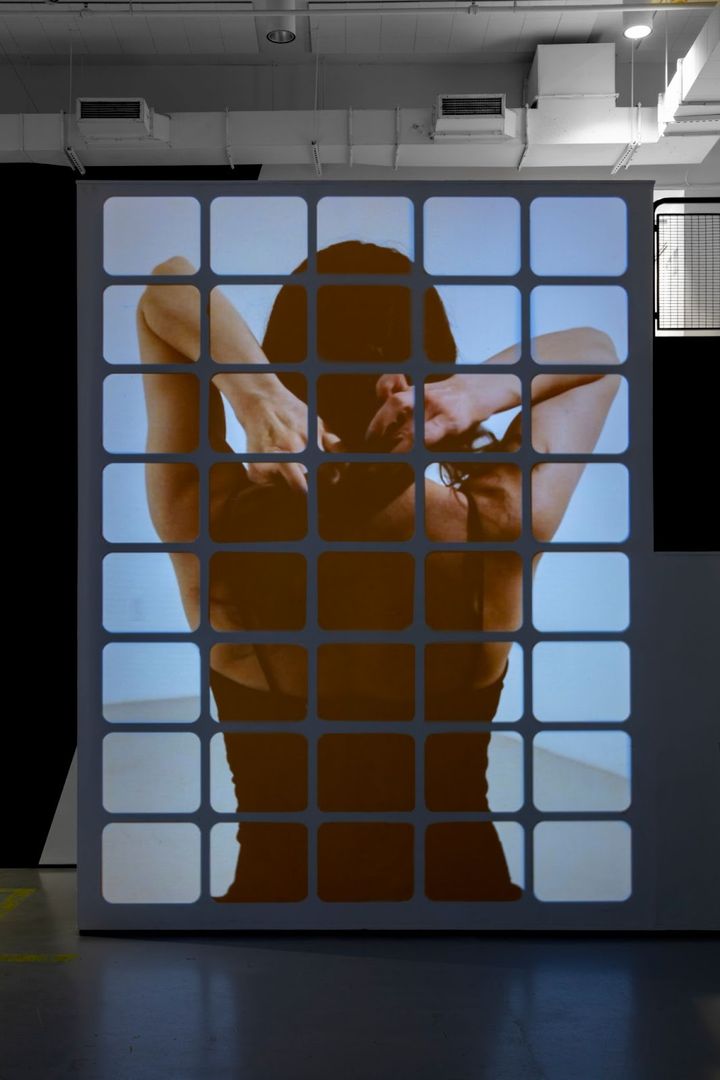
Presented in a vertical format and divided into a grid of moving images, the work unfolds through fragments. Each cell contains a gesture: cutting, unbraiding, repetition, distortion. Together, they form a visual system that mirrors the structural fragility of language itself. Alakbarli constructs this divided screen in order to show how alphabets, like bodies, can be split, reorganized, and rendered unstable.

The piece is rooted in the turbulent history of the Azerbaijani alphabet. In the 20th century alone, Azerbaijan’s script changed three times: from Arabic to Latin in the 1920s, from Latin to Cyrillic during Soviet rule, and from Cyrillic back to Latin after independence. These were not aesthetic adjustments. They were political acts. Each shift disrupted generational continuity. Grandparents became unreadable to grandchildren. Libraries became inaccessible. Memory fractured across scripts.

Alakbarli created How to Destroy Language in order to examine how the first step in dismantling a culture is often the disruption of its language. Rather than dramatizing destruction, she focuses on quieter mechanisms: censorship, translation, technological neglect, bureaucratic reform. The work asks what happens when the architecture of communication is slowly restructured, and who holds the authority to rewrite it.
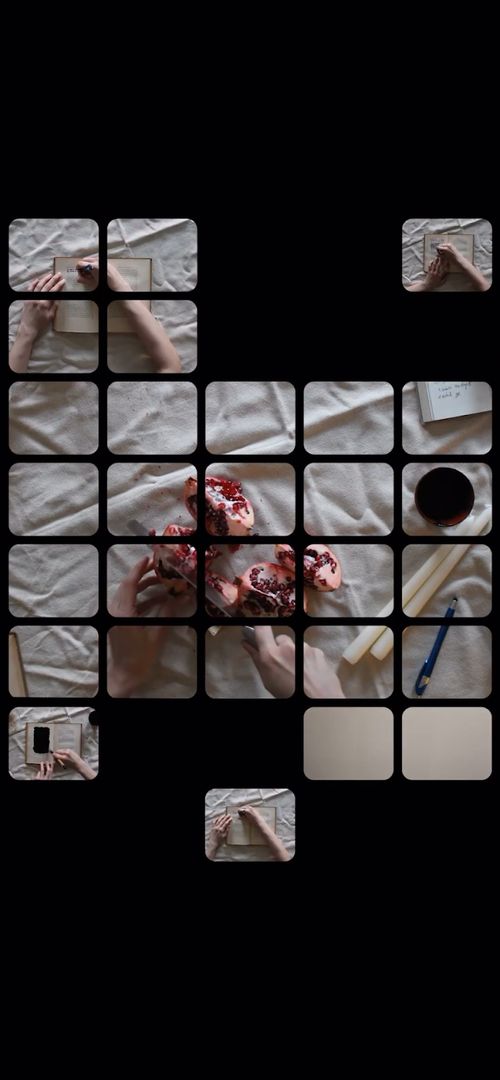
Image ID: kix.ruoh94kt4iam

Fragile Symbols

Throughout the installation, culturally significant elements appear and transform.

A pomegranate, a symbol deeply embedded in Azerbaijani identity, associated with fertility, multiplicity, and continuity — is slowly cut open. Alakbarli performs this gesture to visualize fragmentation from within. The fruit does not explode; it separates. The seeds remain intact, but the structure that once held them together is altered.

In another sequence, braids are undone and redone repeatedly. The braid becomes a metaphor for lineage and transmission. By unweaving and reweaving it, Alakbarli illustrates rupture and reconstruction, the careful labor required to restore continuity after disruption.

The gestures are intimate and deliberate. Within the grid structure, repetition transforms them into systems. The body becomes both agent and archive.
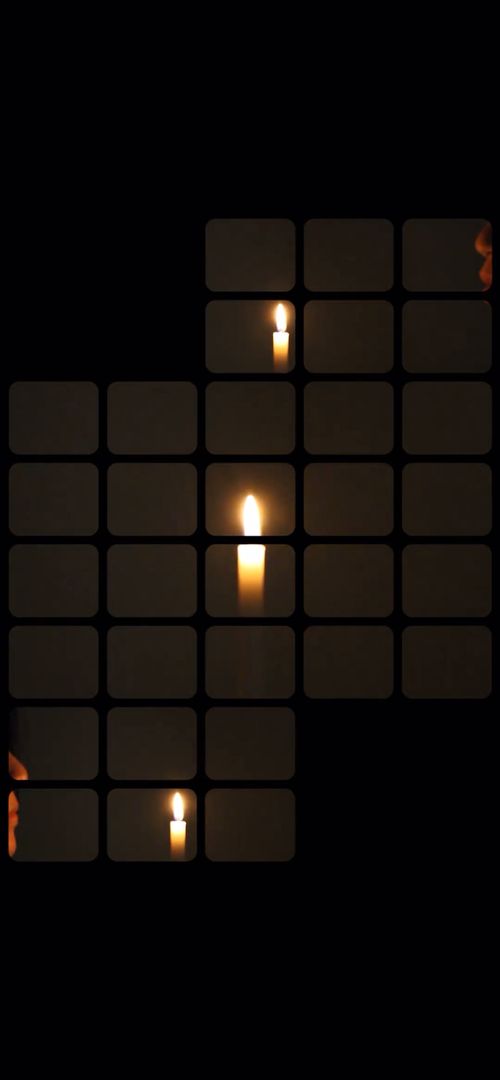
Image ID: kix.m0kwbnqrty4y

Silence as Structure

The video is entirely silent. Alakbarli removes sound in order to foreground absence, what cannot be spoken, archived, or translated. The silence becomes a structural device, mirroring the experience of encountering a text written in an unfamiliar script.

The vertical format subtly references contemporary digital interfaces. Language today lives on screens, in compressed files, social platforms, translation algorithms. By adopting the proportions of the smartphone, Alakbarli situates her work within the same technological systems that can both preserve and erode cultural memory.

How to Destroy Language was exhibited during the Nasimi Festival at Shirvanshahs’ Palace (Shirvanshahlar Sarayı), Azerbaijan’s oldest museum site. Installed within historic stone architecture that has endured centuries of political change, the work entered into dialogue with its surroundings, permanence confronting instability.

The installation was presented alongside members of Atash Hub, a collective of artists who engage critically and collaboratively with Azerbaijani cultural heritage. Within this context, Alakbarli’s work functioned not only as reflection but as responsibility.

Ultimately, How to Destroy Language situates language between power and vulnerability. Alphabets emerge as both political instruments and fragile architectures of memory. Through quiet gestures of dismantling and repair, Alakbarli asks: Who has the power to write history, and who risks becoming unreadable?

Link for the video: https://www.aylin.works/how-to-destroy-language

Continue reading

thumbnail for article titled Type That Screams: How Woojung Lee is Turning Text into a Protest

Type That Screams: How Woojung Lee is Turning Text into a Protest

In the modern digital landscape, information is often consumed in a near-silent vacuum. We scroll through headlines of catastrophe and captions of urgency on mute, flattening the texture of global crises into static pixels. But what happens when typography refuses to be silent? How do you capture th

2026-01-26

Latest articles

Similar articles

thumbnail for article titled The Art of Nourishment: Mon Jajaja's Whimsical Depictions of Food and Happiness

The Art of Nourishment: Mon Jajaja's Whimsical Depictions of Food and Happiness

Mon Jajaja's vibrant and playful illustrations capture the simple pleasures of everyday life through food. The artist's unique style brings a sense of joy and whimsy to each scene, inviting viewers to slow down and appreciate the beauty in everyday moments.

8 days ago

thumbnail for article titled Local artist Ian Archie Beck brings serenity to quintessential English homes with his captivating works.

Local artist Ian Archie Beck brings serenity to quintessential English homes with his captivating works.

A recent exhibition at a London gallery showcases the serene landscapes created by British artist Ian Archie Beck. His paintings capture the quiet charm and everyday beauty often overlooked in suburban settings.

2020-04-02

thumbnail for article titled The Art World is Evolving with Choreus at its Forefront

The Art World is Evolving with Choreus at its Forefront

Choreus, a pioneering platform, is revolutionizing the way artists connect with galleries and collectors by streamlining the traditional art industry's slow pace. By leveraging blockchain technology, Choreus ensures transparency, security, and efficiency in art transactions, giving artists more control over their work and fairer compensation.

2023-05-21

thumbnail for article titled Sarah Elawad's art is infused with sentimental flair and emotional depth.

Sarah Elawad's art is infused with sentimental flair and emotional depth.

Sarah Elawad's art studio is a vibrant reflection of her personality, where bold colors and eclectic patterns come together to create an immersive experience. Each piece is imbued with a sense of warmth and intention, as if the emotions and energy of her creative process are palpable in every brushstroke.

2 days ago

thumbnail for article titled Artificial intelligence pioneer Refik Anadol seeks to strip away the mystique surrounding generative art.

Artificial intelligence pioneer Refik Anadol seeks to strip away the mystique surrounding generative art.

Turkish artist Refik Anadol uses artificial intelligence to create visually stunning, large-scale installations that explore the relationship between technology and nature. His work delves into the possibilities of AI in creative fields, aiming to move beyond the superficial appeal of digital art and tap into its deeper potential.

2017-06-16

thumbnail for article titled Juhyeon Yeon: Building an Acting Career Through Dance, Culture and Community in Los Angeles

Juhyeon Yeon: Building an Acting Career Through Dance, Culture and Community in Los Angeles

An actress rooted in performance Juhyeon Yeon is a Korean actress and cultural performer based in Los Angeles who is consciously shaping a career that places acting at its center while drawing on dance and live events to broaden her artistic range. Rather than treating cultural performance as a

2026-07-03

thumbnail for article titled British artist Jesse Darling claims 2023 Turner Prize for pushing boundaries

British artist Jesse Darling claims 2023 Turner Prize for pushing boundaries

Contemporary artist Jesse Darling has won the 2023 Turner Prize, a prestigious British art award, for her thought-provoking work that pushes boundaries and challenges societal norms. Darling's use of unconventional materials in her pieces further solidifies her position as a leading voice in the contemporary art world.

2017-10-04